Does Microwaving Food Destroy Nutrients or Cause Harm?
Verdict: Overstated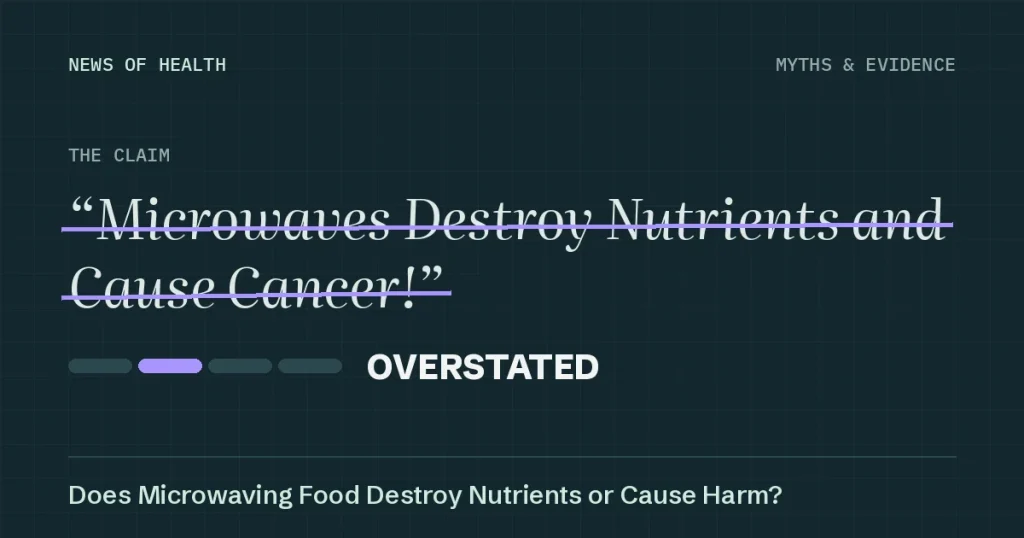
You have probably seen a dramatic headline or a social media post claiming that your microwave is destroying the nutrients in your food. Sometimes, these warnings go further, suggesting that using a microwave can create harmful compounds or even cause cancer.
These claims are persistent and can cause real anxiety. They tap into our desire to eat healthfully and our distrust of things we do not fully understand. But when you look at the scientific evidence, a much different and more reassuring picture emerges.
How microwave ovens cook food
To understand the effects of microwaving, it helps to first understand how it works. Microwave ovens use a type of energy called microwaves, which are a form of electromagnetic radiation. This is the same broad category of energy that includes radio waves, visible light, and X-rays.
The microwaves produced by the oven cause water molecules in food to vibrate rapidly. This vibration generates friction between the molecules, which in turn produces heat. This heat is what cooks the food. It is a fundamentally different process from a conventional oven, which heats the air around the food, or a stovetop, which heats a pan through conduction.
Because microwaves primarily heat water, foods with high water content, like fresh vegetables, cook very quickly. The energy from the microwaves penetrates the food to a certain depth, cooking it from the inside out, which is why it is so much faster than many other cooking methods.
Do microwaves destroy nutrients?
This is the most common concern, and the simple answer is that all cooking methods can reduce the nutrient content of food to some degree. Nutrients, particularly certain vitamins, are sensitive to heat, light, and water. The key factors that determine nutrient loss are how high the temperature gets, how long the food is cooked, and how much liquid is used.
Because microwaving cooks food quickly and often uses very little water, it is frequently better at preserving nutrients than other methods. For example, water-soluble vitamins like vitamin C and the B vitamins can leach out into cooking water. When you boil vegetables, a significant portion of these vitamins can be lost down the drain. Since microwaving typically involves steaming with minimal water, more of these vitamins are retained in the food itself.
Some studies have compared different cooking methods. They consistently find that cooking methods that use less water and shorter cooking times, like steaming and microwaving, are superior for preserving water-soluble vitamins. In contrast, boiling and pressure cooking tend to result in greater nutrient losses. For fat-soluble vitamins and minerals, most cooking methods, including microwaving, have a minimal effect.
Fears about radiation and cancer
The word “radiation” can sound scary, but it is important to distinguish between different types. Microwaves use non-ionizing radiation. This means the energy is strong enough to make molecules vibrate and create heat, but it is not strong enough to knock electrons off atoms or damage DNA. Damaging DNA is the mechanism by which ionizing radiation, like X-rays and gamma rays, can increase cancer risk.
Microwave ovens are designed with safety as a primary concern. They have metal shields and screens that prevent the microwaves from escaping. The oven will not operate unless the door is properly closed. The amount of radiation that could potentially leak from a modern, undamaged microwave is far below the level considered safe by international standards. This energy also dissipates very quickly with distance. There is no plausible mechanism by which the non-ionizing radiation from a microwave oven could make your food radioactive or cancerous.
Some claims suggest that microwaving creates carcinogenic compounds in food. In reality, high-temperature cooking of any kind can create potentially harmful compounds. For example, grilling or frying meats at very high temperatures can form substances called heterocyclic amines (HCAs) and polycyclic aromatic hydrocarbons (PAHs). Because microwaving uses lower temperatures than frying or grilling, it is less likely to create these particular compounds. The risks from cooking methods are often related to specific foods, like the difference in risk for red meat vs. processed meat.
How strong is the evidence?
The evidence on microwave safety is extensive and comes from decades of research. We have a solid scientific understanding of how microwaves work, based on the principles of physics. Studies on nutrient retention have been conducted in laboratory settings where researchers can precisely control cooking times, temperatures, and methods, then measure the nutrient content of the food before and after. Evaluating claims about cancer risk requires looking at the evidence, as is the case for questions like does coffee cause cancer.
These controlled experiments are very good at showing cause and effect. They consistently show that microwaving is comparable to or better than other common cooking methods for preserving many nutrients. The idea that microwaving is uniquely destructive is not supported by this body of experimental evidence.
When it comes to long-term health risks like cancer, evidence comes from large observational studies that follow thousands of people over many years. In these studies, researchers have not found a link between eating microwaved food and an increased risk of cancer. Major health organizations that review cancer evidence have concluded that there is no good evidence that microwave ovens cause harm when used correctly.
Using plastic containers in the microwave
A separate but related concern is about the safety of heating food in plastic containers. Some plastics contain chemicals, such as phthalates and bisphenol A (BPA), that can leach into food, especially when heated. These chemicals are known as endocrine disruptors, meaning they can interfere with the body’s hormones.
For this reason, it is crucial to only use containers that are specifically labeled as “microwave safe.” This label means the container has been tested and found to be safe for use in the microwave. It is made of a type of plastic that does not contain these leachable chemicals or that releases them at levels far below what is considered harmful.
You should never use the following in a microwave unless they are explicitly marked as safe for it:
- Takeout containers
- Single-use plastic tubs (like for yogurt or margarine)
- Plastic wrap that is not labeled microwave-safe (and even then, it should not touch the food)
- Cracked or old plastic containers
If you are concerned, the simplest solution is to heat your food in glass or ceramic containers. These materials are stable and do not pose a risk of leaching chemicals into your food.
When to see a doctor
Concerns about microwaving are generally not a reason to see a doctor. The consensus from health authorities is that it is a safe method of cooking. However, you should speak with a doctor or a registered dietitian if you have broad concerns about your diet, nutrition, or potential exposure to harmful substances.
Consult a healthcare professional if you experience persistent digestive issues, unexplained weight loss, or other new symptoms that you think might be related to your diet. These are general signs that something may be wrong, but they are not specifically linked to using a microwave. A professional can help you evaluate your overall eating habits and address your health concerns based on evidence, not fear.