Does Coffee Cause Cancer? An Evidence-Based Look
Verdict: Not supported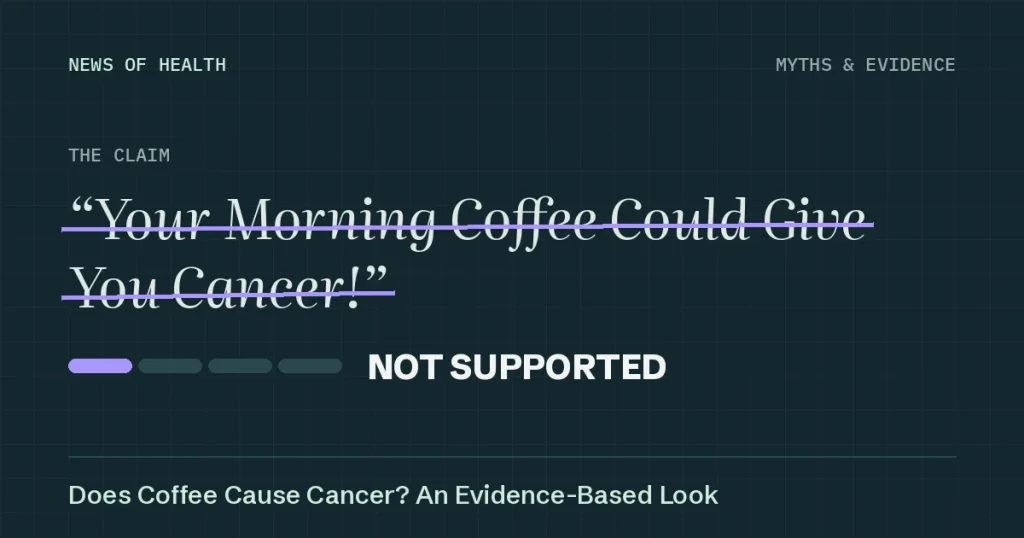
The idea that a daily habit as common as drinking coffee could be linked to cancer is alarming. Headlines suggesting this connection appear from time to time, often causing confusion and concern. It is the kind of health scare that spreads quickly, because coffee is one of the most popular beverages in the world, enjoyed by billions of people every day.
But is there any truth to this claim? When scientific bodies investigate the link between coffee and cancer, the story becomes much more complex and, for coffee drinkers, mostly reassuring. Let’s look at what the overall body of evidence actually says about your daily cup.
The Origin of the Cancer Concern
The worry about coffee and cancer is not entirely new. For decades, researchers have studied components of our diet to understand how they might influence our long-term health. Coffee, being a complex beverage with hundreds of different compounds, naturally came under scrutiny. Early studies, looking back at the habits of people who had developed certain cancers, sometimes suggested a possible link, particularly with bladder cancer.
A specific chemical called acrylamide also fueled the controversy. Acrylamide is a substance that can form in some foods during high-temperature cooking processes, such as frying, roasting, and baking. It forms from natural sugars and amino acids in the food. Because coffee beans are roasted at high temperatures, coffee does contain small amounts of acrylamide, and this compound has been shown to cause cancer in animal studies at very high doses.
This led to public health warnings and even legal challenges in some places, demanding that coffee be labeled as a potential cancer risk. These events created powerful headlines that stuck in the public mind, even as the scientific picture evolved and became clearer. The initial concern was based on limited evidence and a focus on a single chemical, rather than the effects of drinking the whole beverage.
What Does the Broader Evidence Show?
When scientists want to understand the link between a dietary habit and a disease, they look at a huge amount of evidence from different types of studies. Over the past few decades, a vast number of studies have examined coffee consumption and cancer risk. Major international health organizations have since conducted comprehensive reviews of all this evidence.
These large-scale reviews have consistently reached a different conclusion than the initial scares suggested. The World Health Organization’s cancer agency, for example, reviewed a large body of research on the question. Based on this extensive evidence, it concluded that coffee could not be classified as a cause of cancer. In fact, the evidence pointed in the opposite direction for several types of cancer.
Specifically, regular coffee consumption is associated with a lower risk of developing certain cancers, most notably liver cancer and endometrial cancer. Some evidence also suggests a potential reduced risk for other cancers, though the findings may be less consistent. The initial fears about bladder cancer have not been substantiated by more rigorous, modern research.
Understanding the Evidence and Its Limits
Most of the evidence on coffee and cancer comes from observational studies. These studies follow large groups of people over many years, recording their habits (like how much coffee they drink) and tracking their health outcomes. They are excellent for finding associations or patterns, such as observing that coffee drinkers seem to get liver cancer less often. However, they cannot definitively prove cause and effect. People who drink coffee might also have other lifestyle habits that protect them from cancer.
The gold standard for proving causation is a randomized controlled trial, where one group is assigned to drink coffee and another is not. For long-term outcomes like cancer, this kind of study is nearly impossible and unethical to conduct over the decades it would take for cancer to develop. Therefore, we must rely on the patterns seen across many large, well-designed observational studies. When dozens of these studies from different populations all point in the same direction, our confidence in the finding grows.
What about acrylamide? While it is a concern at high doses in lab animals, the amount we get from a typical diet, including coffee, is far lower. Human bodies also process chemicals differently than rodents. The consensus among most food safety authorities is that the low levels of acrylamide in a normal diet are unlikely to pose a significant cancer risk. Furthermore, coffee contains many other compounds, like antioxidants and polyphenols, that are thought to have protective effects, which may outweigh any potential risk from acrylamide.
The Real Risk: Hot Beverages
The one major warning that emerged from the comprehensive reviews was not about coffee itself, but about temperature. The evidence suggests that regularly drinking any beverage at very high temperatures (above 149°F or 65°C) is probably a cause of esophageal cancer. This is not a chemical effect of the drink, but a physical one. Repeatedly scalding the cells lining the esophagus can cause chronic inflammation and damage, which over time can increase the risk of cancer developing.
This risk applies to very hot tea, maté (a traditional hot infusion popular in South America), or any other liquid, including coffee. It is the heat, not the beverage, that is the problem. In many cultures where drinking scalding hot beverages is common, rates of this specific cancer are higher.
For most coffee drinkers in places like North America and Europe, this is not a major concern. Coffee is often served at a hot but drinkable temperature, or people let it cool before drinking. The key takeaway is simple: let your hot drinks cool down a bit before you sip them. There is no need to drink them at a temperature that burns your mouth.
How Much Coffee Is Safe?
For most healthy adults, the evidence suggests that moderate coffee consumption is not only safe but may even have health benefits. What counts as moderate? General guidance from health authorities usually points to about 3 to 5 cups of standard coffee per day, which corresponds to roughly 400 milligrams of caffeine.
Of course, individual sensitivity to caffeine varies. Some people may experience side effects like anxiety, sleeplessness, or an upset stomach with much less. It is also important to consider what you add to your coffee, and if you are swapping sugar for a substitute, it is worth knowing what the evidence says about artificial sweeteners. Loading it up with sugar and cream can add significant calories and saturated fat, which can have their own negative health consequences if done in excess. Its effect on sleeplessness is a common concern, and it helps to know how much sleep adults really need.
Certain groups should be more cautious with caffeine intake, including:
- Pregnant people: Health bodies often recommend limiting caffeine intake during pregnancy.
- People with certain medical conditions: Those with anxiety disorders, certain heart conditions, or issues with caffeine metabolism may need to limit or avoid coffee.
- Children and adolescents: High caffeine intake is not recommended for young people.
Ultimately, for the average adult, the evidence around cancer risk should be reassuring. Your coffee habit is unlikely to be a cause for concern in this regard.
When to see a doctor
Concerns about cancer risk should always be discussed with a healthcare professional who knows your personal and family medical history. They can provide guidance tailored to your specific situation. While coffee is not a recognized cancer risk, other lifestyle factors are.
You should see a doctor if you experience any persistent and unexplained symptoms that could be signs of cancer. These can include unexplained weight loss, chronic fatigue, a lump or thickening anywhere on your body, persistent pain, a nagging cough or hoarseness, or a change in bowel or bladder habits. These symptoms do not automatically mean you have cancer, but they warrant a professional evaluation to determine the cause.