CBD Products: What Does the Science Say?
Verdict: Overstated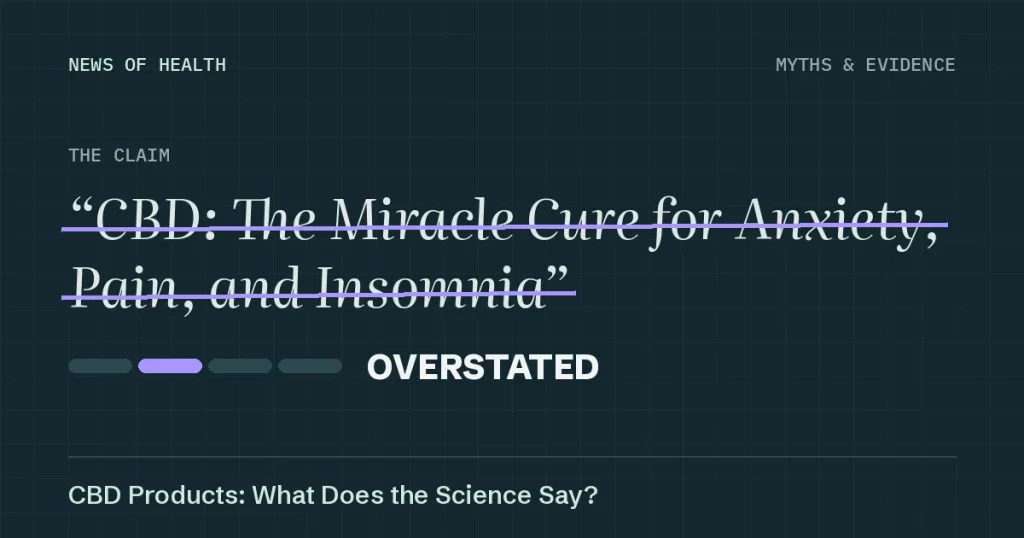
You have likely seen cannabidiol, or CBD, everywhere. It appears in oils, creams, drinks, and snacks, often promoted as a natural remedy for everything from anxiety and chronic pain to poor sleep and skin conditions. The claims are bold, suggesting CBD is a harmless, plant-based cure-all that can improve your wellbeing with few downsides.
This widespread promotion, combined with its association with the cannabis plant, has created a lot of interest and confusion. Many people are curious about whether CBD lives up to the hype, but it can be difficult to separate marketing promises from scientific fact. Let’s look at what the evidence actually says about what CBD can and cannot do for your health.
What is CBD and how does it work?
CBD is one of numerous chemical compounds known as cannabinoids found in the cannabis plant. Unlike the most famous cannabinoid, tetrahydrocannabinol (THC), CBD is not psychoactive. This means it does not produce the “high” associated with marijuana use. Most CBD products are derived from hemp, a variety of the cannabis plant that is very low in THC.
The human body has its own complex cell-signaling system called the endocannabinoid system (ECS). This system helps regulate a range of functions and processes, including sleep, mood, appetite, memory, and pain sensation. The body produces its own molecules, called endocannabinoids, that bind to cannabinoid receptors throughout the brain and body to keep these functions in balance.
CBD is thought to interact with the ECS, but not in the same way as THC. Instead of binding directly to the main cannabinoid receptors, scientists believe CBD works by preventing the body’s own endocannabinoids from being broken down. This may allow them to have a greater effect on the body. It may also influence other receptors in the body, which could explain its potential effects on pain and anxiety.
The strongest evidence: Epilepsy
The most robust and convincing scientific evidence for CBD’s medical use is in the treatment of certain rare and severe forms of epilepsy. Years of research, including high-quality randomized controlled trials, led to the regulatory approval of a specific, prescription-only CBD medication. This medication is used to treat seizures associated with conditions like Lennox-Gastaut syndrome and Dravet syndrome, particularly in children.
In these clinical trials, the purified, high-dose CBD product was shown to be significantly more effective than a placebo at reducing the frequency of severe seizures. This is a clear case where the benefits have been rigorously tested and proven to outweigh the risks under medical supervision. The successful development of this drug is what opened the door to wider interest in CBD’s other potential health benefits.
However, it is a big leap from this specific medical use to the consumer products sold in stores and online. The approved drug is a highly purified, precisely dosed pharmaceutical product prescribed by a doctor for a specific condition. This is very different from the oils, gummies, and lotions available over the counter, which are not regulated in the same way and contain widely varying amounts of CBD.
Anxiety, pain, and sleep: What the research shows
Beyond epilepsy, CBD is most popularly used for anxiety, chronic pain, and sleep problems. The evidence in these areas is much less conclusive and is still emerging. For anxiety, some small-scale human studies and animal research suggest CBD may have a calming effect. However, many of these studies are short-term and use doses that may be different from what is found in consumer products. We need larger, more robust clinical trials to understand if CBD is a reliable treatment for anxiety disorders.
The picture for chronic pain is similarly mixed. Some research suggests CBD may help with certain types of pain, such as nerve pain, by interacting with the body’s pain-signaling systems. But systematic reviews of the existing studies often conclude that the evidence is of low quality. Many studies combine CBD with THC, making it difficult to isolate the effects of CBD alone. For common conditions like back pain or arthritis, there is not yet strong evidence to recommend CBD over other, more established treatments.
Many people who use CBD report that it helps them sleep better. This could be a direct effect on sleep regulation or an indirect one, by reducing anxiety or pain that might be keeping them awake. Research into CBD as a sleep aid is in its early stages. Some studies have found potential benefits, while others have found none. The right dose for improving sleep is also unclear, with some research suggesting that low doses might even be stimulating rather than sedating. Understanding how much sleep adults really need is a key part of improving sleep quality.
How to weigh the evidence
When you hear about a health claim, it helps to understand the strength of the evidence behind it. The highest quality evidence comes from systematic reviews of multiple randomized controlled trials (RCTs). In an RCT, people are randomly assigned to receive either a treatment or a placebo, and neither they nor the researchers know who is getting what. This design helps to eliminate bias.
Much of the research on CBD for pain, anxiety, and sleep comes from other types of studies, which have more limitations. These include:
- Animal studies: Research on mice or rats can provide useful clues, but the results do not always translate to humans.
- Laboratory studies: Experiments on cells in a petri dish can help scientists understand how a substance might work, but they cannot predict how it will affect a whole person.
- Observational studies: These studies look at groups of people and track their health outcomes, but they cannot prove cause and effect. People who choose to use CBD might be different in other ways from those who do not.
- Small-scale trials: Early clinical trials with only a small number of participants can suggest a potential benefit, but their results need to be confirmed in much larger studies involving much larger groups of people.
For CBD, the evidence for treating rare epilepsy is strong because it is backed by large, well-designed RCTs. For most other popular uses, the evidence is still in the early stages and is not yet strong enough to draw firm conclusions. This same approach helps us understand what the evidence says about intermittent fasting and other popular health trends.
Risks and product quality concerns
While often marketed as natural and safe, CBD is not without risks. Potential side effects can include fatigue, diarrhea, and changes in appetite and weight. CBD can also interact with other medications, such as blood thinners, by affecting how the body metabolizes them. This is why it is crucial to speak with a healthcare professional before trying CBD, especially if you have an existing health condition or take other medicines.
A significant concern with the consumer CBD market is the lack of regulation. Because most CBD products are sold as supplements, not medicines, they do not undergo the same rigorous testing for safety, quality, and effectiveness. Studies that have tested commercially available CBD products have found that many are mislabeled. A product might contain significantly more or less CBD than advertised, or it might contain undeclared THC.
Some products have also been found to be contaminated with pesticides, heavy metals, or other harmful substances. Without strict, independent oversight, it is very difficult for a consumer to know if the product they are buying is safe or if it even contains what the label says it does. This makes it challenging to rely on these products for a consistent health effect.
When to see a doctor
Self-treating a health condition with over-the-counter products without medical advice can be risky. It is important to see a doctor or other qualified healthcare professional to get an accurate diagnosis and discuss evidence-based treatment options. You should seek professional medical advice if you are experiencing persistent symptoms that are affecting your quality of life.
Specifically, make an appointment if you have chronic pain that does not go away or makes it hard to perform daily activities. If you experience feelings of anxiety, worry, or panic that are overwhelming and interfere with your work or relationships, it is important to get help. Similarly, if you consistently have trouble falling asleep, staying asleep, or you feel tired all the time despite getting enough hours in bed, a doctor can help identify the cause and recommend effective strategies.