What Does the Evidence Say About Intermittent Fasting?
Verdict: Overstated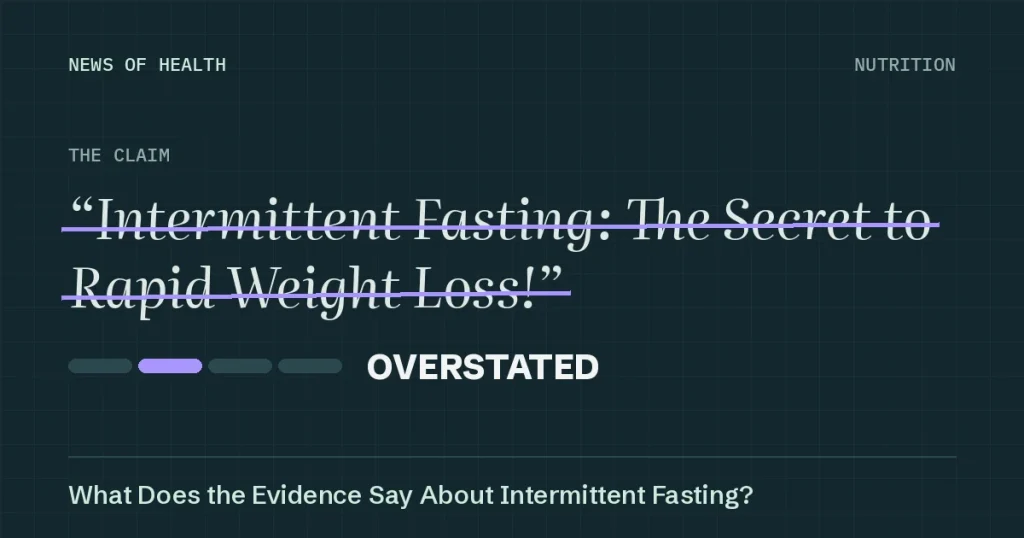
Intermittent fasting is often presented as a uniquely effective way to lose weight and improve health, from reversing aging to boosting brainpower. This eating pattern, which focuses on when you eat rather than what you eat, has gained immense popularity through social media, books, and celebrity endorsements.
The appeal is clear: it offers a structured plan that feels simpler than counting calories. But behind the sensational claims lies a more complex scientific picture. Let’s look at what is actually known about the effects of intermittent fasting on the body.
What is intermittent fasting?
Intermittent fasting is not a diet in the conventional sense. It’s an eating pattern that cycles between periods of eating and voluntary fasting. Instead of telling you which foods to eat, it specifies when you should eat them. This approach has been practiced for centuries for cultural and religious reasons, but it has recently been adopted as a health and weight loss strategy.
There are several popular methods, each with a different schedule for eating and fasting windows. The core idea behind all of them is to give your body a prolonged break from digesting and processing food.
Common approaches include:
- Time-restricted eating: This involves eating all your daily meals within a specific window of time, typically 6 to 10 hours, and fasting for the remaining 14 to 18 hours. A popular version is the 16/8 method, where you fast for 16 hours and eat during an 8-hour window, for example, from 12 p.m. to 8 p.m.
- The 5:2 diet: With this method, you eat as you normally would for five days of the week. On the other two, non-consecutive days, you significantly restrict your calorie intake, often to around a quarter of your usual amount.
- Alternate-day fasting: This involves alternating between days of normal eating and days of complete or near-complete fasting. Some variations allow for a small number of calories on fasting days.
The theory is that these extended fasting periods trigger metabolic changes. When you haven’t eaten for a while, your body exhausts its sugar stores and starts burning fat for energy. This process is sometimes linked to a range of cellular repair processes and hormonal shifts that advocates claim are beneficial for health.
Does it work for weight loss?
For many people, the primary motivation for trying intermittent fasting is to lose weight. The good news is that multiple studies show it can be an effective tool for this purpose. When you limit your eating window, you often naturally consume fewer calories overall, which leads to weight loss. Systematic reviews of clinical trials have found that various intermittent fasting plans can lead to meaningful weight loss in people who are overweight or have obesity.
However, the key question is whether it works better than traditional, continuous calorie restriction, that is, simply eating a little less at every meal, every day. Here, the evidence is less clear. When researchers compare groups of people on intermittent fasting with groups on conventional calorie-cutting diets, the amount of weight lost is often very similar. A major review of studies concluded that intermittent fasting is not superior to standard calorie restriction for weight loss.
This suggests that the magic may not be in the timing itself, but in the calorie deficit it helps create. For some people, having a strict time-based rule is easier to follow than constantly monitoring portion sizes. It can reduce the number of decisions you need to make about food each day. For others, going long periods without eating can lead to intense hunger, overeating during the eating window, and may not be sustainable in the long run. Combining dietary changes with a consistent walking routine can also support sustainable weight management.
What about other health benefits?
Beyond weight loss, intermittent fasting is often promoted for a wide array of health benefits, including improved heart health, better blood sugar control, and even a longer life. Some of these claims are supported by promising early research, primarily from animal studies, but the evidence in humans is still developing.
Some human trials have shown that intermittent fasting can lead to improvements in metabolic health markers. These can include reductions in insulin resistance, which is a key factor in type 2 diabetes. Other studies have found positive changes in blood pressure, cholesterol levels, and markers of inflammation. These are all important factors for cardiovascular health. The proposed mechanism is that fasting gives the body a break, allowing it to engage in cellular cleanup and repair processes. It is also helpful to understand what your cholesterol numbers mean for your overall health.
However, it is often difficult to separate the effects of fasting from the effects of the weight loss that usually accompanies it. Losing excess body fat, no matter how it is achieved, is known to improve most of these same health markers. Some studies that have controlled for weight loss have found that the metabolic benefits of intermittent fasting were no greater than those from traditional dieting. More research is needed to determine if fasting itself has unique benefits for humans, independent of its effect on weight.
How strong is the evidence?
Understanding the limits of the research is crucial. Much of the early, exciting evidence for the profound benefits of fasting, such as its effects on aging and cellular repair, comes from studies on yeast, worms, and rodents. While these studies are essential for forming hypotheses, their findings do not always translate directly to human biology. Humans are far more complex, and our lifestyles and environments are much less controlled.
Human research on intermittent fasting includes observational studies and randomized controlled trials. Observational studies look at large groups of people and their habits over time, but they can only show associations, not cause and effect. For example, if people who naturally eat in a smaller window are healthier, it could be due to other lifestyle factors, like being more health-conscious overall.
Randomized controlled trials are the gold standard for evidence. In these studies, participants are randomly assigned to either an intermittent fasting group or a control group (often a traditional diet). These trials provide stronger evidence, but many have been small and short-term. It is challenging to draw firm conclusions about long-term health effects, like preventing heart disease or extending lifespan, from studies that last only a few months. We need larger, longer-term trials to fully understand the benefits and potential risks.
When to see a doctor
Intermittent fasting is not safe or appropriate for everyone. You should speak with a doctor or registered dietitian before making significant changes to your eating patterns, especially if you have an existing health condition. It is particularly important to seek medical advice if any of the following apply to you:
- You have type 1 or type 2 diabetes, as fasting can affect blood sugar levels and medication needs.
- You are pregnant, breastfeeding, or trying to conceive.
- You have a history of an eating disorder.
- You take prescription medications, especially those that need to be taken with food or that affect blood pressure or blood sugar.
- You are underweight or have a low body mass index (BMI).
- You have a condition like low blood pressure or a heart condition.
Also, if you try intermittent fasting and experience persistent negative side effects like dizziness, severe headaches, fatigue, or difficulty concentrating, it may not be the right approach for you. A healthcare professional can help you find a safe and sustainable way to meet your health goals.