Are Eggs Bad For Your Heart?
Verdict: Overstated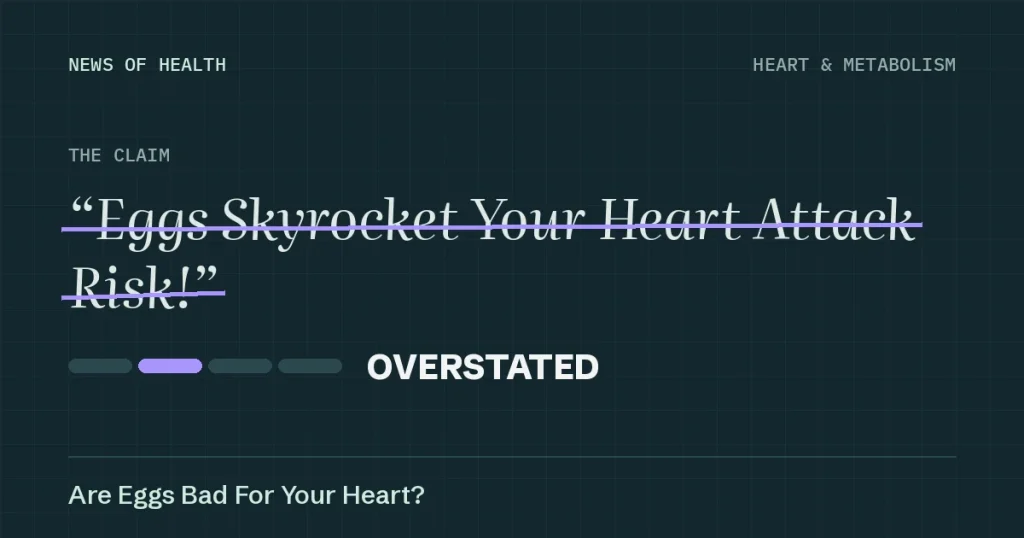
Why the worry about eggs?
Eggs have been at the center of a long-running nutritional debate. For decades, they were singled out as a food to limit or avoid due to their high cholesterol content, which was thought to directly contribute to high blood cholesterol and, in turn, heart disease. A single large egg yolk contains a significant amount of the previously recommended daily limit for dietary cholesterol.
This concern was based on a straightforward, logical idea: since high levels of LDL cholesterol (often called “bad” cholesterol) in the blood are a major risk factor for heart disease, and eggs are high in cholesterol, then eating eggs must raise blood cholesterol and increase heart disease risk. This assumption shaped dietary guidelines for many years, leading many people to opt for egg-white omelets or cut back on eggs entirely.
However, the human body is more complicated than this simple equation suggests. For most people, the cholesterol we eat has a much smaller effect on our blood cholesterol levels than the types of fat we consume, particularly saturated and trans fats. Our livers produce the majority of the cholesterol in our bodies, and they regulate this production based on our dietary intake. When you eat more cholesterol, your liver generally produces less, and vice versa. This understanding has shifted the focus in dietary guidance away from single nutrients like dietary cholesterol and towards overall dietary patterns.
What does the evidence say now?
Over the years, a large body of research has investigated the link between eating eggs and heart health, with results that can seem confusing and contradictory. Many large observational studies, which follow large groups of people for many years, have found no significant association between moderate egg consumption (up to about one egg per day) and the risk of heart disease or stroke in the general population.
Some studies, however, have pointed to a potential increase in risk, particularly among people who eat higher quantities of eggs. These conflicting results are often what fuels confusing headlines. It is difficult to isolate the effect of one single food. People who eat a lot of eggs might also be more likely to eat other foods high in saturated fat, like bacon and sausage, or have other lifestyle habits that contribute to heart disease risk. Researchers try to account for these factors, but it is always a challenge.
More controlled experiments, called randomized controlled trials, have also been conducted. In these studies, researchers actively give groups of people different amounts of eggs to eat and then measure changes in their cholesterol levels. These trials generally show that while eating eggs can increase LDL (“bad”) cholesterol for some people, it often also raises HDL (“good”) cholesterol, which helps protect the heart. The effect of eggs on blood cholesterol also varies greatly from person to person, partly due to genetics. Learning more about LDL and HDL can help you understand what your cholesterol numbers mean.
Saturated fat, not just cholesterol
The conversation about diet and heart health has broadened. While the cholesterol in eggs was once the main villain, attention has shifted to the overall nutritional package of a food and, more importantly, the entire dietary pattern. Saturated fat and trans fat have a much greater impact on blood cholesterol levels and heart disease risk than dietary cholesterol does for most people.
Foods high in saturated fat include fatty meats, processed meats like bacon and sausage, butter, and full-fat dairy products. Trans fats are found in some fried foods and commercially baked goods. When you eat these fats, your liver responds by producing more LDL cholesterol. This is why major health organizations now emphasize reducing saturated and trans fat intake as a primary strategy for managing blood cholesterol and protecting your heart. The health risks can differ between red meat vs. processed meat.
So, how does this relate to eggs? An egg is relatively low in saturated fat. It is a nutrient-dense food, providing high-quality protein, vitamins like D and B12, and minerals. When considering the health impact of eggs, it is crucial to think about what you eat with them. An egg served with a side of spinach and whole-wheat toast is a very different meal from an egg served with processed meat, fried potatoes, and white bread.
How strong is the evidence?
Understanding the types of studies used in nutrition helps explain why the advice can seem to change. Most of the research linking diet to long-term health outcomes like heart attacks is observational. Scientists ask people what they eat and then track their health over many years. This method can identify associations or links, for example, whether people who eat more eggs tend to have more heart attacks, but it cannot prove cause and effect. There could be other factors, known as confounding variables, that are the real cause.
To establish cause and effect, scientists prefer randomized controlled trials (RCTs). In an RCT, participants are randomly assigned to different groups, such as a group that eats eggs daily and a control group that does not. However, it is very difficult and expensive to conduct long-term RCTs for diet. You cannot realistically control everything a person eats for many years to see if they develop heart disease. Therefore, nutrition science must rely on piecing together evidence from different types of studies.
This is why guidelines evolve. As more observational studies are published and smaller, shorter-term trials provide clues about biological mechanisms, the overall picture becomes clearer. The current consensus, based on the totality of evidence, is that for the general population, the small and uncertain risk associated with moderate egg intake is far outweighed by the risks from dietary patterns high in saturated fat, processed foods, and sugar.
So, how many eggs are okay?
There is no magic number of eggs that is right for everyone. For most healthy adults, evidence suggests that eating up to one whole egg per day can be part of a heart-healthy diet without significantly increasing the risk of heart disease. Some research indicates that even more may be acceptable within a healthy eating pattern.
However, recommendations may be different for certain groups. People with existing health conditions should be more mindful. This includes individuals with:
- Type 2 diabetes: Some, but not all, studies have found a link between higher egg consumption and increased risk of heart disease specifically in people with type 2 diabetes.
- Existing heart disease: Those who have already had a heart attack or have high blood cholesterol may be advised to be more cautious with their dietary cholesterol intake.
- Hyper-responders to dietary cholesterol: A portion of the population is genetically more sensitive to dietary cholesterol, meaning their blood cholesterol levels rise more significantly after eating cholesterol-rich foods.
For these individuals, limiting egg yolks to a few per week might be a prudent approach. The most important thing is to focus on the overall diet. A single food is rarely the sole cause of good or bad health. A diet rich in fruits, vegetables, whole grains, lean proteins, and healthy fats is the most effective strategy for preventing heart disease. An egg can easily fit into this pattern. What matters more is what you are not eating: reducing your intake of processed foods, sugary drinks, and foods high in saturated and trans fats will have a much bigger impact on your heart health. It can be helpful to learn more about what are ultra-processed foods and their impact on health.
When to see a doctor
While diet is a key part of managing heart health, it is not a substitute for medical advice. You should consult a doctor or a registered dietitian if you have specific concerns about your diet and heart disease risk. It is especially important to seek professional guidance if you have a family history of heart disease, high cholesterol, or high blood pressure.
Make an appointment to discuss your heart health if you have been diagnosed with conditions like diabetes, kidney disease, or high blood cholesterol. These conditions require careful management, and a healthcare professional can give you personalized advice on diet, including whether you need to limit your egg consumption.
If you are unsure about your cholesterol levels or other risk factors for heart disease, a doctor can order simple blood tests and help you understand your results. They can help you create a comprehensive plan that may include dietary changes, exercise, and, if necessary, medication to protect your long-term health.