Do You Need a Vitamin D Supplement?
Verdict: Overstated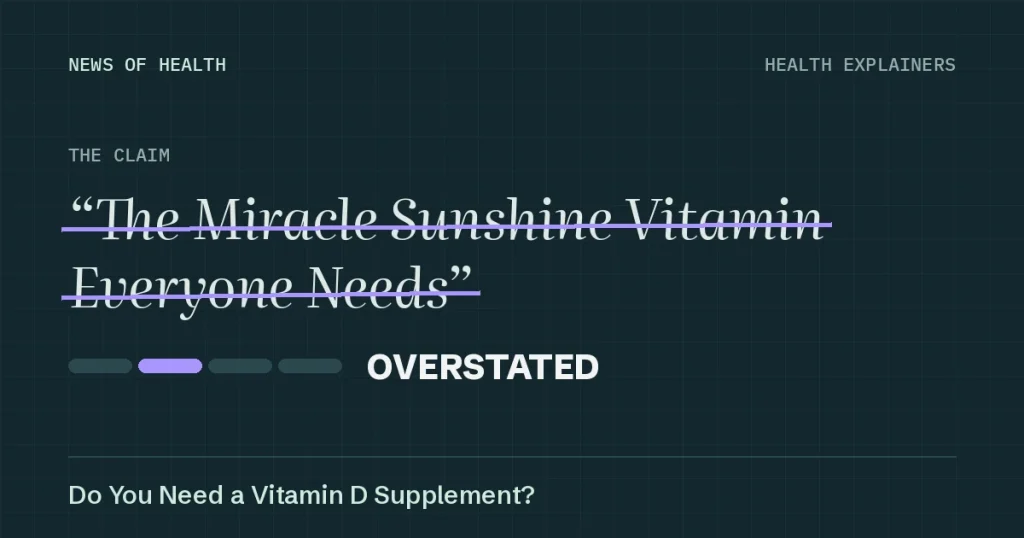
Vitamin D is often called the “sunshine vitamin,” and headlines frequently suggest that most of us are deficient and could benefit from taking a supplement. The claims are broad, linking low vitamin D to everything from weak bones and a poor immune system to heart disease and depression.
This has fueled a massive market for vitamin D supplements, with many people taking them in the belief they are protecting their long-term health. But while this vitamin is undeniably important, the idea that nearly everyone needs a supplement is not supported by the strongest scientific evidence. Let’s look at what vitamin D does, who is truly at risk of deficiency, and what the research says about supplementation.
What does vitamin D do?
Vitamin D’s most well-established role is helping the body absorb and use calcium and phosphorus, two minerals that are essential for building and maintaining strong bones. Without enough vitamin D, the body cannot effectively absorb calcium from the gut. This can lead to soft, weak bones, a condition called rickets in children and osteomalacia in adults. In older adults, inadequate vitamin D and calcium intake contribute to osteoporosis, a disease where bones become porous and fragile, increasing the risk of fractures.
Your body produces most of its vitamin D when your skin is exposed to ultraviolet B (UVB) rays from the sun. This process is very efficient. For many people, just a short amount of midday sun exposure on the arms and legs a few times a week during the warmer months can produce all the vitamin D they need. It can also be found in some foods. Fatty fish like salmon, mackerel, and sardines are good natural sources. Some foods, such as milk, yogurt, orange juice, and breakfast cereals, are fortified with vitamin D.
Beyond bone health, researchers have explored vitamin D’s potential role in many other areas of the body. It is involved in immune function, muscle function, and cell growth. Because it has these roles, it has been studied for its potential to prevent or treat a wide range of conditions, including respiratory infections, cancer, autoimmune diseases, and cardiovascular disease. However, the evidence for these benefits is much less clear than its role in bone health. Getting adequate rest is also vital for immune function, but many people wonder how much sleep adults really need.
Who is at risk for low vitamin D?
While widespread deficiency is often overstated, some groups of people are genuinely at higher risk of not getting enough vitamin D. The primary factor is a lack of sun exposure, which is the main source of vitamin D for most people.
Several factors can limit your ability to produce vitamin D from sunlight:
- Limited sun exposure: People who are homebound, live in institutions like care homes, or cover their skin for religious or cultural reasons get very little sun. Those living in northern latitudes, where the sun is weaker for many months of the year, are also at higher risk, particularly during winter.
- Darker skin tone: Melanin, the pigment that makes skin darker, reduces the skin’s ability to produce vitamin D from sunlight. People with darker skin need more sun exposure than people with lighter skin to produce the same amount of vitamin D.
- Older age: As people age, their skin becomes less efficient at producing vitamin D. Older adults are also more likely to spend more time indoors and may have a lower dietary intake.
- Certain health conditions: Conditions that affect fat absorption, like Crohn’s disease, cystic fibrosis, and celiac disease, can reduce the absorption of vitamin D, which is a fat-soluble vitamin. Severe liver or kidney disease can also impair the body’s ability to convert vitamin D into its active form.
For these specific groups, the risk of having low vitamin D levels is real and may have significant health consequences, primarily for their bones. This is where targeted supplementation, often guided by a health professional, can be very important.
What does the evidence on supplements say?
Understanding the science behind vitamin D supplementation requires looking at different types of studies. Much of the initial excitement about vitamin D came from observational studies. These studies look at large groups of people, and many found that individuals with lower blood levels of vitamin D also had higher rates of various diseases, like heart disease, certain cancers, and infections. This created an association, suggesting that low vitamin D might cause these problems. This is a common challenge when evaluating health claims, including questions about whether coffee causes cancer.
However, an association is not proof of cause and effect. It could be that low vitamin D is a consequence of poor health, not the cause. For example, people with chronic illnesses often spend more time indoors and may not eat a healthy diet, both of which can lead to lower vitamin D levels. This is known as reverse causation. To determine if taking a vitamin D supplement actually prevents disease, we need randomized controlled trials (RCTs). In these trials, one group of people is given a vitamin D supplement and another is given a placebo (a dummy pill), and their health outcomes are compared over time.
When it comes to vitamin D, the results from large, high-quality RCTs have been largely disappointing for benefits outside of bone health. For the general population, major trials have not shown that vitamin D supplementation prevents cancer, heart attacks, strokes, or type 2 diabetes. Similarly, while it was hoped that vitamin D could boost the immune system to ward off colds and flu, trial results have been inconsistent. Some reviews suggest a modest benefit for preventing acute respiratory infections, but the effect appears small and may be greater in those who are very deficient to begin with.
For bone health, the evidence is stronger, but mainly for specific at-risk populations. Systematic reviews show that vitamin D, taken with calcium, can help reduce the risk of fractures in older adults living in institutions. The benefit for generally healthy, active older adults living in the community is less certain. For the general adult population without specific risk factors, there is little evidence that routine supplementation prevents fractures or osteoporosis.
How much is too much?
Just because something is good for you does not mean that more is always better. Vitamin D is a fat-soluble vitamin, which means your body stores any excess. Taking extremely high doses of vitamin D for a long time can lead to toxicity. This is rare and almost always caused by taking massive doses of supplements, not by sun exposure or diet. The body naturally regulates the amount of vitamin D produced from sun exposure. Similar questions about dosage apply to other nutrients, such as when considering cutting back on salt.
Vitamin D toxicity can cause a buildup of calcium in the blood, a condition called hypercalcemia. This can lead to nausea, vomiting, weakness, frequent urination, and more serious problems like bone pain and kidney issues, such as the formation of calcium stones. Official guidelines provide a tolerable upper intake level, which is the maximum daily intake unlikely to cause harmful effects. For adults, this is generally set at 4,000 International Units (IU) per day.
Most over-the-counter supplements come in various doses, which are typically well below the upper limit. However, some products are available in much higher doses. It is crucial to follow the recommended dosage on the product or the advice from your doctor. Unless you are being treated for a diagnosed deficiency under medical supervision, there is no proven health benefit to taking very high doses of vitamin D, and doing so introduces unnecessary risks.
When to see a doctor
While routine screening for vitamin D deficiency in the general population is not recommended, you should talk to your doctor if you have specific risk factors or symptoms. Your doctor can help determine if you need a blood test and can recommend an appropriate supplement dose if needed.
Consider speaking with a health professional if you:
- Have a diagnosed bone condition like osteoporosis.
- Have a medical condition that affects your ability to absorb nutrients, such as Crohn’s disease or celiac disease.
- Spend very little time outdoors due to being frail, institutionalized, or working night shifts.
- Have very dark skin and live in a region with limited winter sunlight.
- Are an older adult, especially if you have had a fall or a low-impact fracture.
- Are experiencing symptoms like persistent bone pain, muscle weakness, or fatigue that do not have another clear cause.
A doctor can assess your individual situation, including your diet, lifestyle, and medical history, to provide personalized advice. Self-prescribing high-dose supplements without a clear medical reason is not a good substitute for professional guidance.