Do Multivitamins Actually Improve Health?
Verdict: Overstated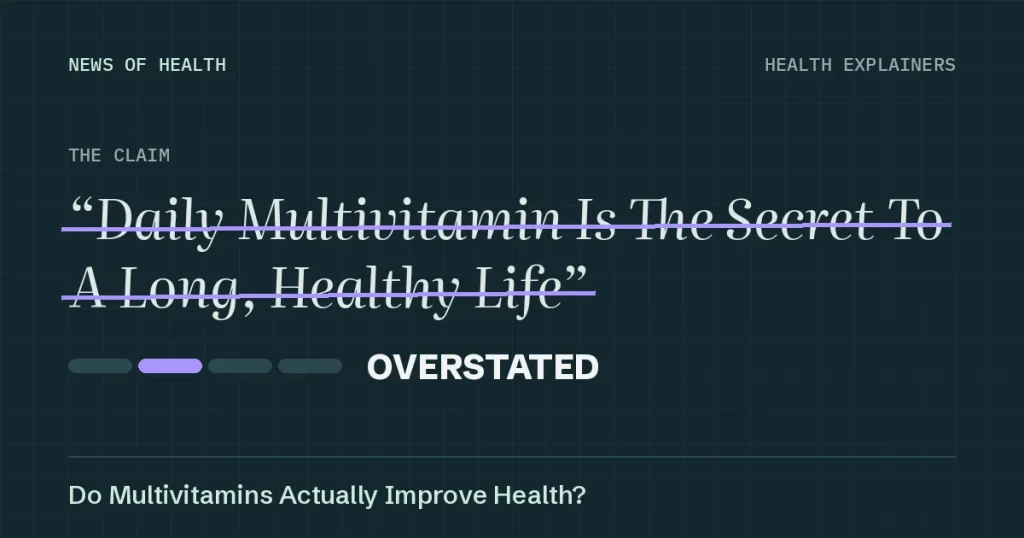
You see them everywhere: bottles promising to fill nutritional gaps, boost energy, and support your overall health with one daily tablet. The idea that a multivitamin can act as a simple insurance policy against a less-than-perfect diet is powerful and appealing.
This belief is fueled by marketing that suggests our modern food supply is lacking and that we all need a little help to get the nutrients we require. But does the scientific evidence support the routine use of multivitamins for the average healthy person? Concerns about diet quality often relate to what are ultra-processed foods.
What are multivitamins?
A multivitamin is a supplement that contains a combination of different vitamins and minerals, sometimes along with other ingredients like herbs or antioxidants. There is no standard definition for what constitutes a multivitamin. The specific nutrients and their amounts can vary dramatically from one product to another.
Some are formulated to provide close to the recommended daily amount of each ingredient, while others might offer much higher doses of certain nutrients. They come in many forms, including tablets, capsules, gummies, and powders. The goal of these products is to supplement the nutrients you get from food.
Because they are sold as dietary supplements, they are not regulated with the same rigor as pharmaceutical drugs. This means that while manufacturers are expected to ensure their products are safe and that the labels are truthful, the claims about their health benefits do not require the same level of pre-market approval as medications. This regulatory landscape also raises questions about if detox teas and cleanses actually work.
The evidence for the general population
For the average healthy adult who eats a reasonably balanced diet, the case for taking a daily multivitamin is surprisingly weak. Decades of research, including large-scale randomized controlled trials, have largely failed to show that routine multivitamin use prevents chronic diseases like heart disease or cancer in the general population.
The thinking is often that if a little of a nutrient is good, more must be better. However, the body is complex. It is designed to absorb nutrients from whole foods, where vitamins and minerals are packaged with fiber, phytonutrients, and other compounds that work together. Isolating these nutrients in a pill does not necessarily replicate these benefits and can sometimes lead to the body simply excreting what it does not need.
This is where the phrase “expensive urine” comes from. Many of the vitamins included in multivitamins, such as B vitamins and vitamin C, are water-soluble. If you take in more of these vitamins than your body needs, the excess is typically filtered out by your kidneys and passed in your urine. Your body cannot store them for later use, so a high-dose supplement often provides no extra benefit.
Understanding the strength of the evidence
When evaluating claims about multivitamins, it is helpful to understand the different types of scientific studies. Much of the early positive association between vitamin intake and health came from observational studies. These studies look at large groups of people over time and can identify links, for example, that people who take multivitamins tend to have better health outcomes. However, these studies cannot prove cause and effect. People who voluntarily take multivitamins often have other healthier habits, such as exercising more, eating a better diet, and having a higher socioeconomic status. This is known as the “healthy user bias,” and it makes it difficult to know if the vitamin itself is responsible for the observed benefits.
To establish causation, scientists rely on randomized controlled trials (RCTs). In these studies, one group is given the multivitamin (the intervention group) and another is given a placebo (the control group). Participants are assigned to groups randomly to minimize bias. When numerous large, long-term RCTs and systematic reviews of these trials have been conducted on multivitamins, they have generally not found significant benefits in preventing major chronic diseases for the average person.
It is also important to consider the difference between preventing a deficiency and promoting optimal health. Vitamins are essential for preventing deficiency diseases like scurvy (from vitamin C deficiency) or rickets (from vitamin D deficiency). These are rare in developed countries. The claim that multivitamins can go beyond preventing deficiency to actively ward off diseases like cancer or heart disease in well-nourished people is what lacks strong support from trial evidence.
Who might actually benefit from a supplement?
While a multivitamin may not be necessary for everyone, some specific groups of people can benefit from supplementation. These recommendations are often for specific single nutrients rather than a broad-spectrum multivitamin, based on particular needs.
Key groups who may need supplements include: It is worth learning more about whether you need a vitamin D supplement.
- Pregnant people: Folic acid is crucial before and during early pregnancy to prevent birth defects of the brain and spine. Iron is also often recommended to support fetal development and prevent anemia in the mother. Prenatal vitamins are specifically formulated to meet these increased needs.
- Older adults: As people age, their ability to absorb certain nutrients, like vitamin B12, can decrease. They may also get less sun exposure, leading to lower vitamin D levels, which is important for bone health.
- People with dietary restrictions: Vegans and strict vegetarians may need to supplement with vitamin B12, which is found almost exclusively in animal products. They may also need to pay attention to their intake of iron, calcium, and vitamin D.
- Individuals with malabsorption conditions: People with conditions like celiac disease, Crohn’s disease, or who have had certain types of weight-loss surgery may not be able to absorb enough nutrients from their food and often require supplementation under a doctor’s care.
- Those with a diagnosed deficiency: If a blood test reveals a specific nutrient deficiency, such as iron-deficiency anemia, a doctor will prescribe targeted supplementation to correct it.
In these cases, the supplement is addressing a specific, identified need rather than acting as a general health booster.
When to see a doctor
You should speak with a doctor or registered dietitian before starting any new supplement, including a multivitamin. They can help you determine if you have a genuine need based on your diet, lifestyle, age, and health status. A healthcare professional can also recommend the right nutrient and dosage to avoid potential risks.
It is especially important to seek medical advice if you are experiencing symptoms that might indicate a nutrient deficiency, such as persistent fatigue, hair loss, brittle nails, or unusual changes in your skin. These symptoms can have many causes, and self-diagnosing with a multivitamin is not a substitute for a proper medical evaluation.
Finally, if you are pregnant, planning to become pregnant, breastfeeding, or have a chronic medical condition, always consult your doctor. They can provide personalized advice on your nutritional needs and ensure that any supplement you take is safe and appropriate for you.