How Accurate Are Sleep Trackers?
Verdict: Overstated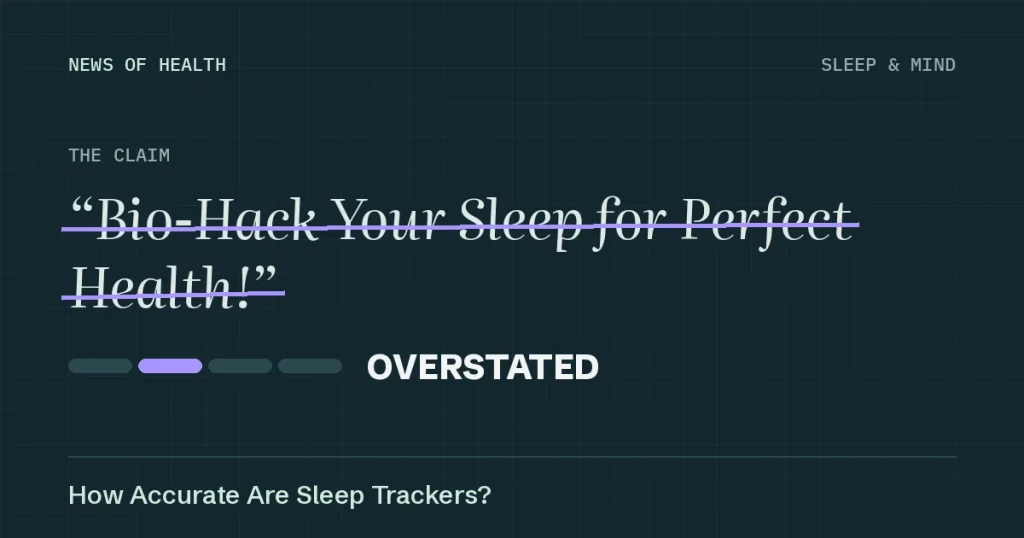
Wearable trackers and bedside apps promise to reveal the secrets of your sleep, offering detailed charts of your light, deep, and REM cycles. Ads and influencers suggest that optimizing these numbers is the key to better health, energy, and focus. The idea that you can bio-hack your way to perfect sleep is compelling.
But how accurate are these devices, and can they deliver on their promises? While sleep trackers can be useful tools for building awareness and good habits, their data comes with significant limitations. Understanding what they measure, and what they only estimate, is essential to using them effectively without adding a new layer of stress to your bedtime routine.
How Sleep Trackers Work
Most commercial sleep trackers, whether they are rings, watches, or mats under your mattress, do not measure sleep directly. Instead, they measure other bodily signals and use algorithms to estimate when you are asleep and in which sleep stage. The most common sensors include accelerometers, which detect movement, and optical heart rate sensors (photoplethysmography or PPG), which measure heart rate and heart rate variability (HRV).
An accelerometer is the simplest sensor. It works on the principle that you move less when you are asleep. The device flags long periods of stillness as sleep. More advanced trackers combine this motion data with heart rate information. Generally, your heart rate slows as you fall asleep and varies predictably through different sleep stages. For example, it tends to be lowest during deep sleep.
Heart rate variability, the small fluctuations in time between heartbeats, also provides clues. Higher HRV is often associated with the parasympathetic nervous system, the “rest and digest” state linked to restorative sleep. By combining data on movement, heart rate, and HRV, the device’s algorithm makes an educated guess about your sleep patterns. Some bedside devices also use microphones to detect snoring or sonar to track respiratory movements.
Rings vs. Watches vs. Bedside Devices
The form factor of a sleep tracker can influence its comfort and data quality. Each type has its own set of advantages and disadvantages.
- Wearable Rings: Rings are small, lightweight, and often more comfortable to wear overnight than a watch. They typically use optical sensors on the inside of the finger, an area with strong blood flow that can yield high-quality heart rate and oxygen saturation data. Their main drawback is often a lack of a screen, requiring you to check an app on your phone for your data.
- Smartwatches and Fitness Bands: These are the most common type of tracker. Their advantage is multifunctionality; they track activity, show notifications, and tell time. However, their size and bulk can be uncomfortable for some to wear while sleeping. The quality of the sensor and its placement on the wrist, where blood flow can be less consistent, may affect the accuracy of the data compared to a finger-based sensor.
- Bedside and Non-Contact Devices: These include mats that go under your mattress, devices that sit on your nightstand, or apps that use your phone’s microphone. Their primary benefit is that you do not have to wear anything. They typically track movement, breathing rates, and sound (like snoring). However, they can be less accurate, especially if you share a bed with a partner or pet whose movements and sounds can interfere with your readings.
Ultimately, the best device is one you will wear or use consistently. Comfort is a key factor. A device that constantly reminds you of its presence might interfere with the very sleep it is supposed to be tracking.
What the Data Means (and What It Doesn’t)
Trackers present you with a dashboard of metrics: total sleep time, time spent in each stage (light, deep, REM), and often a composite “sleep score.” It is crucial to understand that these are estimates, not medical-grade measurements.
The gold standard for sleep measurement is polysomnography (PSG), conducted in a sleep lab. A PSG records brain waves (EEG), eye movements, muscle activity, heart rhythm, and breathing. Consumer trackers have none of this information. They are trying to infer complex brain states from simple body metrics like movement and heart rate. As a result, their accuracy varies.
Most trackers are reasonably good at telling you when you are asleep versus when you are awake. They can give you a fair estimate of your total sleep duration. However, their ability to correctly identify sleep stages is much less reliable. They often struggle to distinguish between light sleep and being awake but still. They are also frequently inaccurate in differentiating between deep and REM sleep. One person’s “deep sleep” reading on one device might be completely different from another’s, or even from the same person on a different brand of tracker.
Therefore, it is best not to get fixated on the nightly sleep stage percentages. Chasing a specific number for deep or REM sleep can lead to anxiety, a condition sometimes called orthosomnia. Instead, these metrics are most useful for observing broad trends over weeks or months. For example, you might notice that your resting heart rate is consistently higher or your sleep duration is shorter on weeks when you are under a lot of stress or drinking alcohol close to bedtime. It can also help you see if you are meeting recommendations for how much sleep adults really need.
The Limits of the Evidence
The claims made for sleep trackers often outpace the scientific evidence. While many studies have compared consumer trackers to the gold-standard PSG, the results are mixed. These validation studies consistently show that trackers are proficient at identifying sleep versus wakefulness but struggle with accurate sleep staging. The algorithms are proprietary, meaning researchers cannot independently verify how they work, and they can change with any software update.
The bigger question is whether using a tracker actually improves sleep or health outcomes. There is not a strong body of evidence from randomized controlled trials to show that simply using a tracker leads to better sleep or health. The device itself does nothing; its value depends entirely on how you use the information it provides. For some people, the data can motivate positive behavior changes, such as maintaining a more consistent bedtime or creating a better sleep environment. This might include managing factors that affect your sleep environment, like the relationship between blue light and sleep.
For others, however, the data can increase anxiety. Receiving a “poor” sleep score after a night you felt you slept well can create a negative feedback loop, where you worry about sleep and consequently sleep worse. It is important to remember that these scores are generated by an algorithm, not a doctor, and should not override your own sense of how rested you feel. Your subjective feeling of restfulness is a powerful and valid indicator of sleep quality.
When to See a Doctor
A consumer sleep tracker is not a medical device and cannot diagnose a sleep disorder. While it might flag potential issues like frequent awakenings or changes in breathing, this information should be seen as a prompt to consult a professional, not as a diagnosis itself. You should consider speaking with a doctor if you experience any of the following, regardless of what your tracker says:
- You consistently have trouble falling asleep or staying asleep.
- You wake up feeling tired or unrefreshed on most days, even after what seems like a full night of sleep.
- You are told by a partner that you snore loudly, gasp, or stop breathing during sleep.
- You experience an overwhelming urge to sleep during the day that interferes with your work or daily activities.
- You have an uncomfortable urge to move your legs, especially in the evening when you are trying to rest.
A doctor can properly assess your symptoms, which may involve a referral to a sleep specialist or a clinical sleep study if needed. Relying solely on a consumer device for a medical issue can delay proper diagnosis and treatment.